The Royal Academy of Engineering’s Spotlight on Spinouts 2026, with data from Dealroom, is the best thing I’ve read on UK research commercialisation this year.
There’s plenty in here worth a look: the UK leads Europe on total spinout value (though Switzerland wins per head), Parkwalk and Oxford Science Enterprises are the busiest investors, exits were worth £2.1bn in 2025 (almost all trade sales, and almost all from Oxford with OrganOx and Oxford Ionics), and the share of spinouts with a female founder is stuck at 17%. Do read the full report. It’s rigorous and specific, and it publishes university-by-university figures that should make a few vice-chancellors wince.
What follows is my take wearing two hats: one as a taxpayer who paid for the research and wants to see a return, and the other as an investor who has to decide whether it’s worth the (large amount of) hassle of working with universities to get spinouts done.
Deeptech is the spinout story
Deeptech dominates the UK spinout landscape. It accounts for 96% of the combined value of UK spinouts, and there are now more than 730 VC-backed Deeptech university spinouts founded since 2010.
Spinouts made up 27% of UK VC-backed Deeptech startups founded between 2010 and 2018. Since 2019 that’s risen to 36%. In photonics (58%) and quantum (56%), more than half of all VC-backed UK startups came out of a university. Semiconductors sit at 37%. If you invest in UK Deeptech, you’re investing in spinouts, so you might as well lean in.
Overall, more than 2,000 spinouts have come out of UK universities since 2010. They’re worth about £49bn and employ 27,000 people, with 70% of those jobs created since 2020.
A word to VCs: it is worth the hassle
Spinouts are a great investment. I say that knowing full well that plenty of VCs won’t touch early-stage spinouts at all. They’ve been burned by months of negotiation, by unreasonable and inconsistent terms, and frankly by the attitude of some TTOs, and they’ve quite reasonably concluded that there are lots of other opportunities, and life’s too short.
However, it is worth it. Of the spinouts that raised a seed round between 2010 and 2020, 28.3% went on to a Series A, against 27.1% for the rest of UK tech. The gap widens further up: 6.9% of spinouts reached Series C against 5.7% for everyone else, about 21% better in relative terms. Spinouts don’t just survive; they scale more reliably than the average British startup.
And investors have more leverage than they think. Universities told the Hickson Review that investors already feel they hold the upper hand, given how few investors there are. A TTO that knows a credible investor is ready to fund and support the company has every reason to move. So engage early. Patiently but firmly ask for standard terms and don’t move. Get the founders to run the licence through the standard checker, educate them and get them to push back. Get a defined timetable. Converge on the commercials rather than relitigating every clause. Yes, it’s frustrating. But it’s economically worth it, and the time you invest will teach the TTOs to respond faster and further increase the spinout success rate.
Try to ascribe positive intent to the TTOs. In most cases they are constrained by multiple interlocking committees, so it’s difficult for them to move without external pressure. So be that pressure and help them.
The bad news: money went elsewhere
UK spinouts raised £1.3bn of VC in 2025, down from £2.2bn in 2024. That’s a fall of roughly 40% in a single year and the lowest total since 2019. Over the same period, VC for the rest of UK tech rose 46%, driven by AI and a fintech recovery.
The best-converting part of the UK startup scene, sitting on the deepest research base in Europe, went backwards in a year when money was flowing everywhere else.
Lots of things feed into that, and we can’t blame licensing terms for all of it. But the Academy itself, launching the report, said spinouts can take 12 to 18 months to launch. That pace is completely [expletive] unacceptable, given that every month a licence negotiation drags on is a month off a market window that is closing.
Look beyond the Golden Triangle
The report is keen to show that spinout activity is spreading across the country, and it is. But the value hasn’t followed yet. I grouped the report’s top 20 universities (Table 1) into regions you can get round in about three hours by train or car:
| Region | Universities in top 20 | VC-backed spinouts | New spinouts since 2022 | Reach $10m+ | Value per VC-backed spinout |
|---|---|---|---|---|---|
| Golden Triangle & South East | 7 | 469 | 147 | 41% | £78m |
| Northern England & Scotland | 8 | 153 | 103 | 26% | £28m |
| Bristol & Wales | 2 | 56 | 19 | 30% | £165m* |
| Midlands | 2 | 44 | 20 | 20% | £13m |
| Northern Ireland | 1 | 22 | 5 | 23% | £15m |
The Golden Triangle produced half of the new spinouts since 2022 but holds almost three-quarters of the value. Northern England and Scotland produced over a third of the new spinouts and hold less than a tenth of the value. The North and Scotland are generating companies at pace; they just aren’t yet getting priced and funded like the ones in Oxford and Cambridge.
Value per spinout isn’t the same as the price of getting in, and some of the gap is real differences in sector mix and maturity. But the direction is obvious. There’s a deep, fast-growing pipeline two to three hours from London where the money is thinner and the valuations much lower. Perhaps a few more VCs should keep a desk in Manchester, Bristol, Belfast or Edinburgh.
The average is getting better; the spread isn’t, and it’s unjustifiable
The headline number has moved a lot. The average university equity stake fell to 16% in 2025, from 25% in 2023 and 25–30% across 2015–19. The median is now 11%. The USIT guides and the 2023 Independent Review did a great job of pulling some of the outliers in; 69 universities have signed up to USIT. However, page 39 of the report breaks the figures down by university, and it’s quite shocking:
| University | Eligible spinouts | Average stake | Median stake |
|---|---|---|---|
| Imperial | 34 | 10% | 8% |
| Royal College of Art | 14 | 6% | 5% |
| Cambridge | 41 | 13% | 10% |
| Swansea | 4 | 11% | 13% |
| Oxford | 48 | 19% | 14% |
| UCL | 13 | 25% | 16% |
| Sheffield | 25 | 23% | 18% |
| Edinburgh | 13 | 24% | 20% |
| Strathclyde | 9 | 19% | 20% |
| Bristol | 13 | 21% | 26% |
| Liverpool | 12 | 27% | 28% |
| Glasgow | 9 | 36% | 30% |
| King’s College London | 8 | 33% | 30% |
| Manchester | 27 | 30% | 30% |
| Queen’s Belfast | 14 | 28% | 31% |
| Birmingham | 10 | 30% | 36% |
| Warwick | 5 | 39% | 40% |
| Newcastle | 9 | 41% | 40% |
| Nottingham | 17 | 38% | 45% |
| Leeds | 11 | 43% | 49% |
The big spinout producers, Imperial, Cambridge and Oxford, have medians of 8%, 10% and 14%. These are the three most prolific spinout factories in the country and the three with the most deal experience. At the bottom: Warwick, Newcastle, Nottingham and Leeds, with medians of 40–49%. Same funding councils, same taxpayer, same national guidance.
While it’s entirely possible that Warwick, Nottingham, Leeds and Newcastle believe themselves to be much better universities than Cambridge, Imperial and Oxford, it’s difficult to believe that even they think they’re four times better.
(Warwick’s figure rests on only five deals, to be fair. The others don’t have that excuse.)
The national average isn’t there yet, but it looks better. However, nobody negotiates with the national average. A founder negotiates once, usually without specialist counsel, against a counterparty that does this multiple times a year using its own familiar licence, and the outcome depends heavily on which building their lab is in, and sometimes on the professor behind the research. That isn’t a market with a norm; it’s a postcode lottery.
So what does the extra equity buy?
If a 45% stake reflected a genuinely bigger institutional contribution, you’d expect that to result in spinouts that raise more or reach significant funding more often. Below is the median stake plotted against the share of each university’s VC-backed spinouts that go on to raise $10m or more. I’ve only included universities that have launched at least ten spinouts since 2022, so every point reflects a currently active programme:
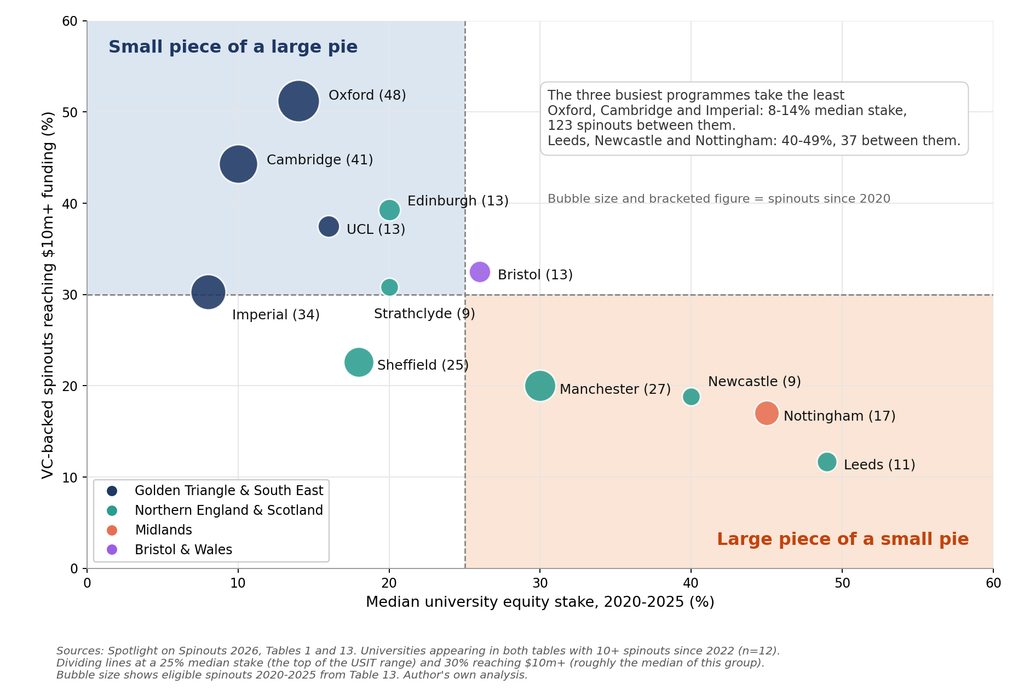
And a clear pattern jumps out: spinout experience goes hand in hand with low equity stakes. Oxford, Cambridge and Imperial, with 123 eligible spinouts between them, take an average median stake of 10.7%, with Imperial at 8%. Leeds, Newcastle and Nottingham have 37 between them and take an average median stake of 44.7%. The universities doing the most deals have converged on low equity. The ones taking the most are doing the fewest.
And it isn’t that experienced offices are more generous; it’s that they’ve worked out what a deal needs to look like for a company to raise, and then raise again. A TTO that has watched forty cap tables develop knows that 40% kills a Pre-Seed or Seed conversation stone dead. A TTO doing three deals a year is negotiating in the dark, against a founder doing it once in their life, with no template and no benchmark.
None of this proves the stakes cause the weaker outcomes; sector mix, scale and local capital all matter. However, the summary is this:
There’s no sign that taking more equity buys better outcomes. Rather, it’s very clear that the companies with inert university equity clogging up their cap tables are struggling to raise.
Recommendation 3 of the Independent Review said HEIF should reduce the need for universities to fund their tech transfer offices out of spinout income. So follow the money. The public funds the research which ends up in patents. The public then funds the office that, slowly, licenses it. Where an equity stake mainly exists to keep the TTO’s lights on, the public pays a third time, in lost growth, at exactly the moment a company’s cap table matters most to incoming investors.
Nobody’s saying universities shouldn’t share in success, or that TTOs should be defunded. The question is whether the current mechanism serves the people who own the asset, and as a taxpayer I want the spinouts to be in the “large pie” category and to generate lots of income and corporation tax, and so should everyone involved.
Equity is only one line in the deal
Equity gets measured because it shows up in Companies House filings. Royalties don’t. Neither do milestone payments, upfront fees, exit fees, anti-dilution terms, haggling over assignment triggers, board rights, or how long it took to get from first chat to signed licence. On that last point, as noted above, it’s 12 to 18 months. Read that again and weep at the pointless waste of people’s time on all sides.
Anecdotally, and from personal experience, that’s exactly where the action has moved. As the visible equity comes down, some universities are layering in extra ways to get paid instead: early licence fees, sub-licensing cuts, milestone payments, royalties stacked on royalties. None of it shows up in the headline statistic, so a university can look USIT-compliant on equity while the overall deal has barely changed. That’s not a conspiracy; it’s what happens when you audit one number and not the rest.
Even the equity number is hard to pin down. This year the Academy found that in about 30% of cases, the earliest available cap table already included dilution from outside investors, so historic university stakes have been under-reported.
Transparency is working
Here’s the really encouraging bit. Every time the terms get more visible, deals get better and faster. This Academy report is part of that. So is the HESA Spinout Register, launched in June 2025, which for the first time gives an official public count of UK spinouts. So is Imperial’s Founders Choice, which publishes the whole package online: equity options, the licence fee, sub-licensing royalties and patent cost recovery, all on one page.
That last one matters because it shows the full deal, not just the equity. When founders know what normal looks like, they spend less time arguing about it. Transparency doesn’t just improve terms; it speeds things up.
The scorecard: where the Independent Review has got to
Part 3 of the report tracks progress against the eleven recommendations of the 2023 Independent Review of University Spinout Companies. Where the report links one to a recommendation in the 2026 Hickson Review, that’s shown too.
| # | Independent Review recommendation (2023) | RAEng status | What the RAEng says | What the SDL does |
|---|---|---|---|---|
| 1 | Innovation-friendly university policies and standard terms, including a template term sheet → Hickson: Accelerate spin-out formation and reduce spinning out too soon | In progress | 69 universities have adopted USIT, but nobody monitors it. The term-sheet template still doesn’t exist. | It is the Deeptech template: two equity options, capped fees, and university response deadlines with deemed consent. |
| 2 | A national spinout register, and universities publishing their typical deal terms → Hickson: Enhance transparency and build trust; improve metrics and tracking | Met | HESA Spinout Register launched June 2025, updated April 2026. | Anonymised reporting to the Spinout Register. One named licence makes terms comparable. |
| 3 | HEIF to cover TTO costs so they don’t depend on spinout income | In progress | HEIF priorities for 2025–31 expect universities to take account of USIT. | Cuts the cost of negotiating each deal by 80%+. |
| 4 | Shared TTOs for smaller research universities → Hickson: Sector-based shared TTOs; mobility and anchoring of spinouts | In progress | 13 pilots (£4.7m, 49 universities). Full results unpublished. | Ready-made documents for shared and smaller TTOs, in English and Scottish law versions. |
| 5 | More proof-of-concept funding before spinning out → Hickson: Boost pre-incorporation and pre-seed funding | Met | £9m UKRI fund backed 48 projects; new round October 2026. Hickson wants £100m a year. | Indirect: fees deferred until a £500k raise, so early cash goes into the technology. |
| 6 | Recognise commercialisation and spinouts in the REF | Incomplete | No substantive change for REF 2029. | SCALE is asking for standard terms to count as evidence of an impact-enabling environment. |
| 7 | Experienced support and negotiation help for founders | Met | Innovate UK’s Velocity programme, though not spinout-specific. Promised mapping of support unpublished. | Openly available, plain-English terms. LLM-assisted help with negotiation, to get founders up to speed and answer their questions. |
| 8 | Entrepreneurship training for UKRI-funded PhD students | In progress | UKRI’s 2024 doctoral training expectations include commercialisation. | Limited direct role. Usable as teaching material. |
| 9 | University-affiliated funds shouldn’t shut out other investors → Hickson: Advance diversity in spin-outs and investment | In progress | New affiliated funds launched in 2025. No evaluation of their effect on competition. | The university is a shareholder like all others and doesn’t have preferential terms. |
| 10 | Continue reforms to scale-up capital → Hickson: Scale-up finance; specialist Deeptech capital | In progress | One £250m LIFTS award; no second. British Business Bank capacity expanded. | Indirect: royalties capped at £10m, no university ratchets or preferences, assignment trigger already in place. A cleaner company to back later. |
| 11 | Funds to help researchers move between academia and industry → Hickson: Strengthen the entrepreneurial culture in academia | In progress | Shown as a second Recommendation 10 in the report. UKRI package includes £4m a year of Enterprise Fellowships. | Predictable and standard terms make spinning out faster, easier and much less angst-ridden. |
Since the Review: Hickson and the REF
Two things have happened since the Independent Review that change the conversation.
The Hickson Review. Deepening University-Investor Links, an independent review by Tony Hickson for UKRI, was published on 3 February 2026. Hickson finds that the pace of spinout formation has become the next most significant issue after equity stakes and investment readiness. Investors told him the process is over-engineered:
- Warranties, indemnities and liability each get negotiated case by case, and investors often want a suite of side agreements on top.
- External lawyers unfamiliar with university spinouts drag things out and inflate costs on both sides.
- Some tech investors deal directly with founders or bypass university channels altogether, producing informal “sneak-outs”.
His fix is a UKRI-convened national task force of universities, investors, the BVCA, the UKBAA and legal experts to cut the time from investor interest to deal completion. It should produce standardised term sheets and IP transfer templates for life sciences, software, Deeptech/hardware and climate tech. These should cover Pre-Seed and Seed, including convertible loans, SAFEs, S/EIS and direct equity. UKRI should publish a list of universities that adopt them.
Hickson is clear that even partial uptake, such as common definitions, reduces friction. And if you’re an investor dealing with multiple universities, then you desperately need common definitions.
The REF. The Research Excellence Framework steers around £2bn a year of research funding, and REF 2029 makes commercialisation impact easier to claim:
- The 2* quality threshold for underpinning research has been removed.
- Indirect and non-linear routes from research to impact are explicitly accepted.
- Early-stage impact counts where a real effect has occurred.
- Engagement with commercial partners is now formally part of the definition of engagement.
But the REF still assesses impact that has already happened. There’s no reward for forming companies faster or for using standard terms, and after the 2025 review the weighting moved further towards research outputs. That’s why the Academy still scores this recommendation as incomplete. With final guidance due this autumn, the quicker levers are in knowledge exchange funding: HEIF and the KEF.
What should happen next
Recommendation 1 of the Independent Review asked universities, investors and founders to build on USIT and produce a template spinout term sheet. Three years on, it doesn’t exist. USIT gives ranges and the Spinout Register gives counts. Neither gives a founder a document to put on the table.
That’s what the SCALE Deeptech Licence is: a single, openly available standard licence for UK university Deeptech spinouts, published by the SCALE Foundation, a not-for-profit, and maintained by an independent Standards Committee. It is built to be consistent with the USIT principles. In short:
- Equity. The university takes either 5% protected from dilution until the company has raised £5m, or 10% that dilutes from day one. There are no ratchets, liquidation preferences or enhanced voting rights.
- Fees. Fees are limited to historic patent costs and a £50,000 licence fee paid over five years. Nothing is due until the company has raised £500,000 or reached its third anniversary, whichever comes first.
- Royalties. There is a 1% royalty on sales, but only once cumulative sales pass £10m. Sub-licensing income carries a royalty that starts at 10% and falls to 1% over nine years to reflect the value added by the spinout. All royalties are capped at £10m in total, with an option to buy them out.
- Speed. The university commits to response times of 10, 15 or 30 business days, depending on the matter. If it misses them without explanation, consent is deemed given.
- Rounds. It works with convertible loans, SAFEs, ASAs and priced rounds.
- Law. It has English and Scottish law versions.
- Reporting. Anonymised data goes to the Spinout Register.
That lets it do three things this report shows are needed.
It tackles the spread, not the average. A 10–25% range allows a massive spread, and that’s what we’ve got. A default document with defined elections (jurisdiction, equity option, reversion) narrows the spread by design.
It’s self-evidencing. Recording which named licence was used, and which options were chosen, is far easier than auditing adherence to principles.
It makes the invisible terms visible. Fees, royalties and response times all sit in the licence, and they’re capped there, so the layering described above has nowhere to hide.
And it answers Hickson directly. His task force needs a Deeptech and hardware IP transfer template. The SDL is ready-made and built on USIT, so it can be that template rather than yet another competitor to it. So the ask is simple:
- UKRI should recognise SDL adoption in its published best-practice list, alongside USIT.
- Universities should publish their IP and licensing policies and say whether they follow recognised standards, as Hickson recommends.
- Government should fund a time-limited SDL pilot across a group of universities and shared TTOs, publishing deal timings before and after.
- Knowledge exchange funding should add time-to-licence to the KEF and the Spinout Register and recognise adoption of standard terms in HEIF allocations.
- The funding bodies should recognise use of standard terms as evidence of an impact-enabling environment in any remaining REF 2029 guidance, and build a speed-of-formation signal into the exercise after 2029.
None of that mandates anything or overrides university autonomy. It just makes standard terms the visible, rewarded and measurable default.
What the SDL doesn’t cover (yet …)
The report raises several things a single Deeptech licence can’t fix on its own.
Software and life sciences. The SDL is a Deeptech licence. Software spinouts are where the report finds stakes furthest above guidance (17% against a recommended 10% or less), and life sciences is the largest segment. Hickson wants templates for four sectors; the SDL covers one because we’re experienced in Deeptech. We’re happy to take help from others at any point.
Northern Ireland. The SDL has English and Scottish law versions. Queen’s Belfast is 18th in the report’s value ranking with 22 VC-backed spinouts, so a Northern Ireland option is an obvious next step, and we’ll take that step.
Spinouts from more than one institution. The SDL is a two-party licence between one university and one company. The report notes over 50 spinouts co-created with research centres, and Hickson counts 91 collaborative spinouts out of 2,307 on the Spinout Register. They need a multi-party version.
The time before signature. The SDL’s response times apply once it’s signed. The 12 to 18 months the Academy complains about mostly happen before that. The Independent Review asked universities to state how long each stage of spinning out should take and to delegate routine approvals. Using standard terms that everyone understands would reduce the timeline dramatically.
Founder vesting and dead equity. The report and the TTOs it consulted like reverse vesting and worry about dead equity. The SDL records how founders divided their equity, but vesting and leaver terms belong in the company’s articles or shareholders’ agreement. A companion note, or a pointer to specific Seed/Pre-Seed founder templates (coming soon …), would help.
Side agreements. Hickson notes investors often want consultancy, facilities access and sponsored research agreements alongside the licence. The SDL protects ongoing sponsored research and handles improvements, but there are no standard companion documents yet.
And some things are outside any licence by design: the supply of capital (the 2025 funding fall, proof-of-concept money, scale-up finance), the REF, PhD training, and the 17% of spinouts with a female founder. A fair, standard licence can remove friction. It can’t create money or change who gets funded.
None of this requires believing universities have behaved badly. The direction since 2023 has been good, and the most founder-friendly institutions got there without being forced. But voluntary guidance has delivered most of what voluntary guidance can. What’s left is the spread between universities, terms nobody measures, and nothing to check against. Those are documentation problems, which are cheap to solve.
The public has spent decades funding this research base. It’s entitled to expect the paperwork to move at the speed of the opportunity.
Spotlight on Spinouts 2026 is published by the Royal Academy of Engineering with data from Dealroom. Deepening University-Investor Links: a review by Tony Hickson was published by UK Research and Innovation on 3 February 2026. The regional groupings and the chart are my own analysis of the Spotlight report’s Tables 1 and 13. The SCALE Foundation is a not-for-profit developing the SCALE Deeptech Licence (SDL), a standard licensing framework for UK university Deeptech spinouts; details here refer to the current draft.